

A star is born
In which I live blog the beginning of Disney's Hercules and talk about over-optimizing our lives.

In the pits of a deep Brooklyn winter, I turn to my favorite Disney movie, Hercules.
This is probably my 30th watch, with most of the count racked up during my youthful VHS days. As an adult, the rewatches dropped off because at some point I realized I only love the first 15 minutes. But what a 15 minutes: heavy hitters like The Muses singing “The Gospel Truth”, Hermes saying “I haven’t seen this much love in a room since Narcissus discovered himself, watching Pegasus mewemewemewemeweing himself to sleep, and getting introduced to my misunderstood twin, Mr. Always-Cooking-Up-a-Plan, Hades.
But this rewatch was different. I made it past the 15-minute mark! And I had a moment of reflection I’ve been sitting on for a while. Which is how I’ve landed on this part live blog, part remarks post. I’m not a critic, I’m not a scholar, I’m not a classicist. I’m just a girl who forced the adults in my life to purchase Hercules plates from Burger King on my behalf.
Here we go!
The 15-min live blog
“But what is the measure of a true hero?”
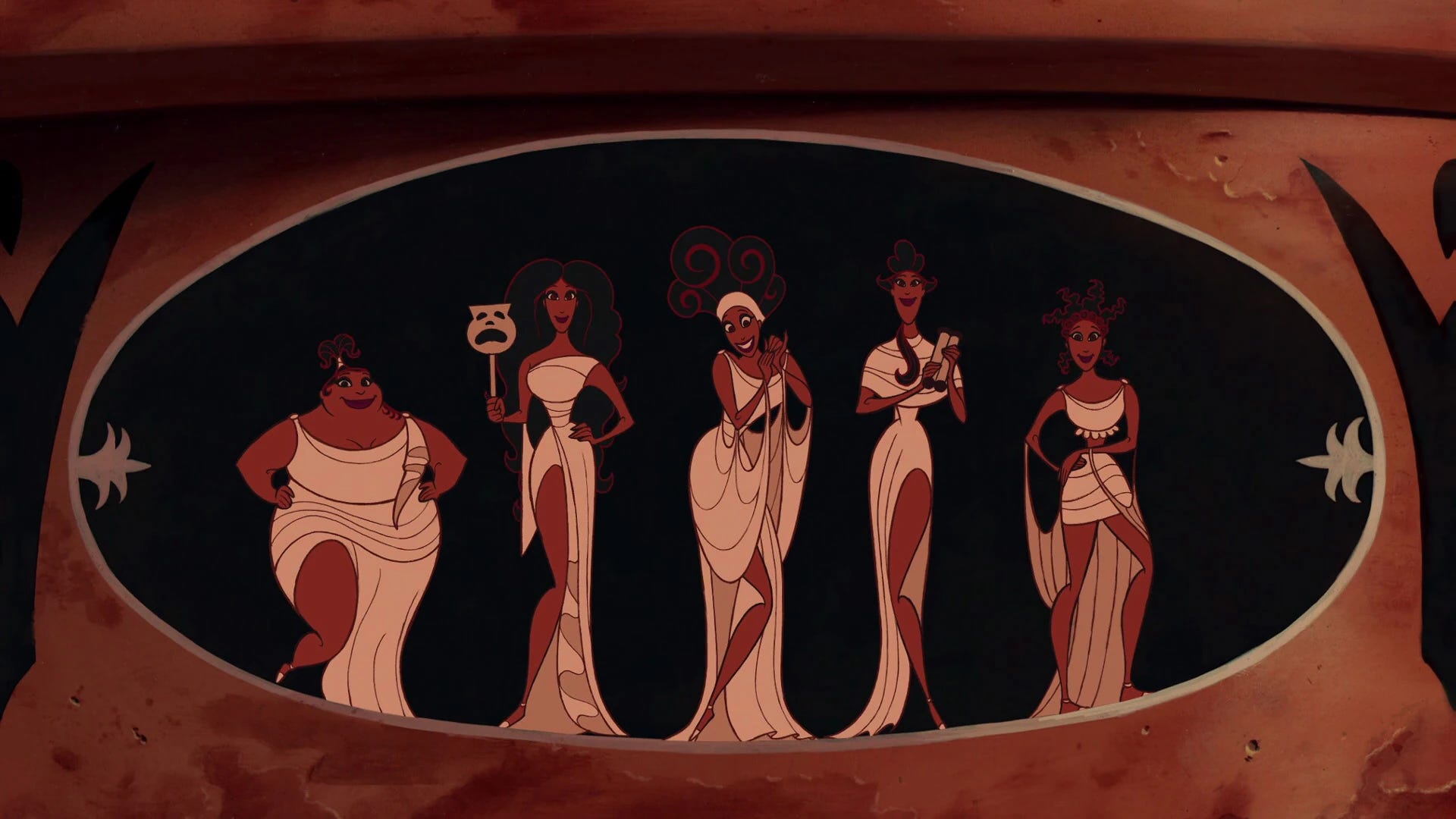
People, people, this is how you start a movie! A booming baritone interrupted by The Muses singing what might be one of the best opening songs ever, all on red-figure pottery! I have always been, and still am, deeply mesmerized with these first few moments.
We move to a party on Mount Olympus in honor of our sunspot, Hercules. The gods are mingling, and Hermes serves as the comic relief with not one but two snarky lines. The mythology references aren’t the most accurate (Hera is not Hercules’ mother, Hercules murdered his wife, Zeus is the worst god to exist), but you can read Edith Hamilton’s Mythology if you want to be a purist!
Every god looks like a shiny object with a subtle gaussian blur and monochromatic coloring that notes their immortality. Zeus is an old John Cena? Hot Santa Claus? Hera is glowing in a magenta bedazzled tunic surely purchased from the Limited Too on Mount Olympus.
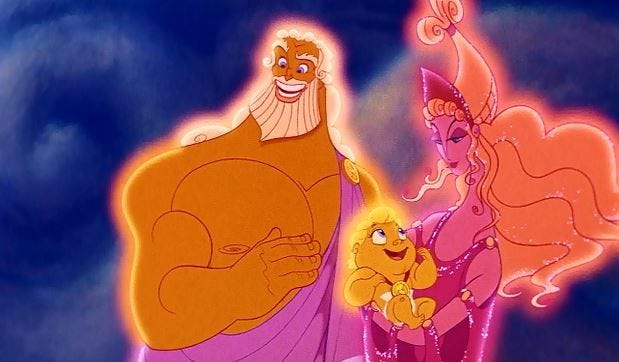
Hercules is adorned with gifts, the most special being Pegasus, his high-flying half horse half bird. Then, Hades, your most lugubriousness, hits the party like every unmotivated uncle who is obligated to attend but sits in the corner recounting all the ways he hates his family.

He returns to home to the underworld where big brother Zeus stuck him with the job nobody wanted, and meets his assistants, Pain and Panic as they prepare for a meeting with The Fates.
The Fates reveal that in 18 years, the planets will align for Hades to release the Titans and overthrow Zeus in a hostile takeover (trés Ellison). But… “a word of caution to this tale, should Hercules fight you will fail.”
Since you can’t kill a god, Hades decides to turn Hercules mortal so he won't be a problem in 18 years.
“If…if is good”
Pain and Panic kidnap baby Hercules, bring him to earth, and force feed him the Make You Mortal potion. When a mortal couple, Alcmene and Amphitryon, turn the corner and startle Pain and Panic, the bottle breaks with just one drop left. Hercules loses his godly gaussian blur but keeps his superhuman strength because he didn’t drink every last drop of the potion. Without his god status, Hercules can't return to Mount Olympus, and he’s adopted by Alcmene (who is Hercules’ mother in mythology) and Amphitryon.
And, like every pair of Oh Shit! siblings, Pain and Panic decide to keep their screw up a secret from Hades.
And that’s the end of the first 15. Onto the reflection!
Point 1: Sorry to this man
This isn’t the real reflection, it’s just what I need to get off my chest :)
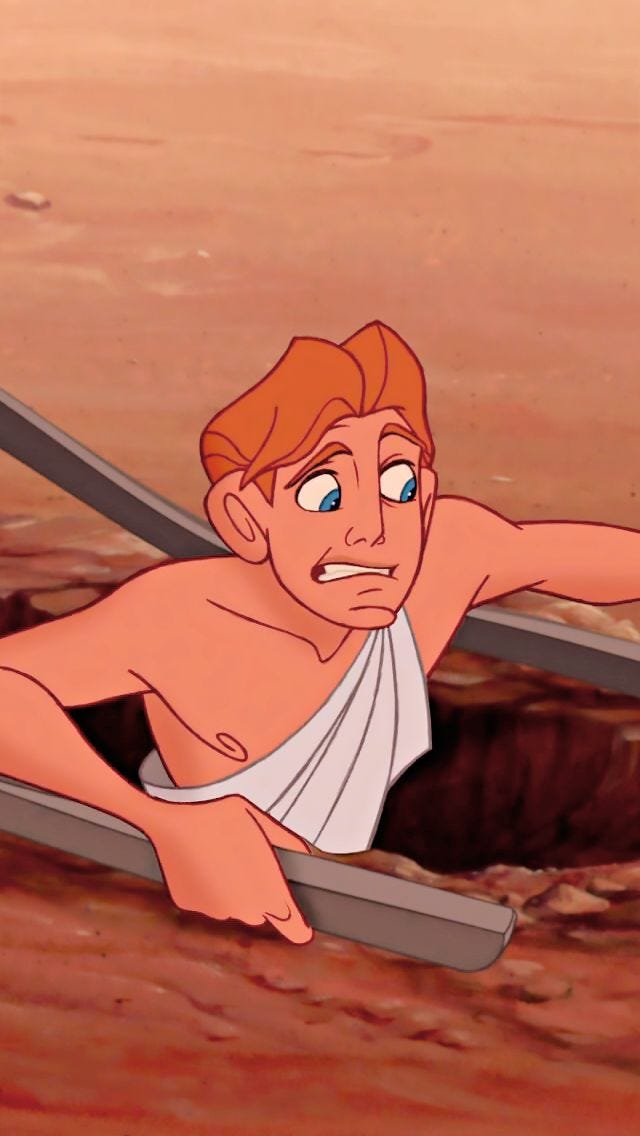
Hercules, as a character, sucks.
For the majority of the movie his angle is to first find himself then prove himself. He knows he’s different, and look, I’m not a monster, I know how painful and awkward being a teen and an outsider can be. But Hercules is always so “aw, gee,” “aw shucks.” He’s a G-rated Kendall Roy and I hate to say it, but he’s the least likeable character in his own story.
It’s a classic Disney story, where an impressionable kid puts their trust in selfish adults who always fail them, (Simba and Scar, Ariel and Ursula), but Hercules is especially dull and it never lands with me.
I promise I love this movie though.
Point 2: The real reflection :)
Earlier in the film, Zeus tells Hercules he can return to Mount Olympus by becoming a true hero. So Hercules spends most of the movie optimizing for godhood. He's already got god strength, but he trains with Phil to get better at it. He becomes famous, gets a shoe deal, signs autographs, trains, trains, trains. The grind never stops, you know.
But, as we later find out, he’s optimizing for the wrong thing. And maybe so are we.
In our mortal world, we've optimized and over-engineered everything so much that odysseys have turned into journeys, and journeys have turned into walks around the block. We streamline, we hack, we automate, we jam. But when there's no meaningful resistance, is there any real transformation?
We all know transformation doesn’t come from optimization. It comes from confusion and rewriting your own answers and asking better questions and experiencing cold. hard. pain. Like, you can’t Atomic Habits your way out of a heartbreak.
I don’t want this to read as a pro-struggle post, because it’s not. There’s a difference between friction that wastes your time (sitting in traffic) and friction that forces you to become someone new (starting a new workout plan). But I fear in an attempt to not fly too close to the water, we’ve flown too close to the sun. We’re designing systems that make people more efficient, not more capable. We’re so focused on getting really good at being ourselves that we’ve forgotten how to become someone new.
Hercules figures it out at the end. He stops #grinding for #godhood and starts fighting to save Meg, even after giving up his strength to do it. When Zeus offers him his immortality and a spot on Mount Olympus, Hercules chooses to stay on Earth as a mortal.
From the outside, it looks like nothing changed. He started as an outcast living among mortals, and he ends the story…living among mortals. But everything in the middle mattered so much more than the outcome. The willingness to lose everything and the choice to stay.
Bringing it home: At the start of the film, the narrator asks, “what is the measure of a true hero?” At the end, Zeus answers, “the true measure of a hero isn’t the size of his strength, but by the strength of his heart.”
I think that’s what we miss when we, and I’m very much including myself in this, obsess over our before-and-after metrics and New Year resolutions. Sometimes the win is just becoming someone who has enough courage to make a different, less optimized choice.
And that’s the gospel truth!!